| Part 1 The Theory of Faith | Hirohumi Hoshika |
Chapter 4 Acquisition of Jesus as the Faith Object (12)
Notes
■Approach
[1] Charlesworth, J. H. Kore dake wa shitte okitai shiteki iesu [The Historical Jesus an Essential Guide]. Trans. Minoru Nakano. Tokyo: Kyōbunkan, 2012. Print. (66).
[2] Refer to Chapter 1 - Supplement 1 "The Fact-Dependent Christian Faith-T/R", Chapter 1- Essay 4 and subsequent sections, as well as Chapter 2- Episode 1.
■Confirmation 1
[1] The explanation regarding Q is as follows. Kloppenborg, S. John, Marvin W. Meyer, Stephen J. Patterson, Michael G. Steinhauser. Q-shiryō Tomasu-Fukuinsho [Q-Thomas Reader]. Trans. Mitsugu Shinmen. Tokyo: Nihonkirisutokyōdan-shuppankyoku, 1996. Print. Yamada, Kouta. "Seisho-gaku no reimei-ki no iesu kenkyū [Jesus studies in the early days of biblical studies]." Iesu kenkyū-shi [History of Jesus Studies]. Tokyo: Nihonkirisutokyōdan-shuppankyoku, 1998. Print.
[2] ibid., Iesu kenkyū-shi [History of Jesus Studies]. (95).
[3] Robinson, James M, Helmut Koester. Shoki kirisutokyō no shisō-teki kiseki [Trajectories through Early Christianity]. Trans. Hisao Kayama. Tokyo: Shinkyo Shuppansha Pub. Co., 1975. Print. (63-65).
[4] Bultmann, R. "Kyōkanfukuinsho denshō-shiⅠ [THE HISTORY OF THE SYNOPTIC TRADITION Part One]." Burutoman chosaku-shū 1 [COLLECTED WORKS 1]. Trans. Hiromichi kayama. Tokyo: Shinkyo Shuppansha Pub. Co., 2004. Print. (68).
[5] New Japanese Bible. Tokyo:Inochinokotoba-sha, 1981. Print. The account in John chapter 4 is not cited as a parallel passage to those in Matthew chapter 8 and Luke chapter 7; the reverse is also true.
[6] The direct answer to this question is stated in "Supplement 3".
■Confirmation 2
[1] Hick, John H. Philosophy of Religion. 4th ed. Englewood Cliffs: A Simon & Schuster, 1990. Print (95).
[2] Seigo Yamaya. "Shin'yaku seisho shisō [New Testament Thought]." Seisho Jiten [Biblical Encyclopedia]. Ed. Tadao Aiura. Tokyo: Nihonkirisutokyōdan-shuppankyoku, 1974. Print. (190).
[3] Thomas Aquinas. Summa Theologica. Ⅱ-Ⅱ, q. 1, a. 2. Shingaku Taizen 15. Trans. Ryōsuke Inagaki. Tkyo: Sōbunsha, 1990. Print. (10).
[4] Kant, Immanuel. Critique of Pure Reason. Trans. Norman Kemp Smith. LONDON: MACMILLAN and Co., 1929. Print. (646). (B850 Paraphrase).
[5] Russell, Bertrand. Shūkyō, Sei, Seiji [Bertrand Russell's Best, SILHOUETTES IN SATIRE]. Trans. Shun Kakimura. Tkyo: Shakai shisō kenkyūkai shuppan-bu, 1960. Print. (39).
[6] Thomas Aquinas. Summa Theologica. Ⅱ-Ⅱ, q. 1, a. 4. respondeo (answer). Shingaku Taizen 15. (17).
[7] Thomas Aquinas. Summa Theologica. Ⅰ-Ⅱ, q. 57, a. 2. Shingaku Taizen 11. Trans. Ryōsuke Inagaki. Tkyo: Sōbunsha, 1996. Print. (151, et al.).
[8] Whether Thomas adopts the view that "faith lies midway between certain knowledge and opinion" can be gathered from ST Ⅱ-Ⅱ, q. 1, a. 4: "Whether the object of faith can be anything seen?" It describes two ways in which the intellect grants approval to a matter—that is, acknowledges it as true. One is when the object of a matter is understood directly or recognized through reasoning based on scientific knowledge (see Note [7] regarding direct understanding [=intellectual insight] and scientific knowledge). Another case is when one volitionally consents that the matter is true. The latter is further divided into two categories: the first is an act of assent accompanied by doubt and fear, termed "opinion", while the second is an act performed with certainty and without fear, known as "faith".
Thus, it is stated that "faith implies assent of the intellect to things believed" (ST Ⅱ-Ⅱ, q. 1, a. 4. respondeo). The phrase "that which is believed [=things believed]" here may seem confusingly redundant with "faith," but its meaning is as follows. Objection (2) in the same article says, "Therefore, the things that are believed are seen", and the reply to objection (3) says, "The light of faith makes the things believed visible". Since it is customary in the Summa Theologica for objections to be refuted, it is concluded that the phrases "the things that are believed" and "are seen" in objection (2) stand in a relationship of opposition.
Furthermore, in the reply to objection (3), it is stated that "things believed" undergo a certain transformation through the light of faith and are "made to be seen", revealing once again that these two concepts stand in opposition to one another. Moreover, the concluding remark of the reply to objection (3) in article 5 clearly states: "What is believed is not what is seen." Regarding this notion of being "seen", the respondeo of the same article notes: "That which moves the intellect or the senses to make itself recognized is said to be 'seen'."
Accordingly, regarding the term "intellect or sense" found in the respondeo: since it is stated in Ⅰ, q. 12, a. 4 respondeo—specifically, that "our soul possesses two cognitive faculties; one is the actuality of a bodily organ, and the intellect serves as the other cognitive faculty"—it refers to a "cognitive faculty".
"Actuality" is a philosophical concept of Aristotle that carries various meanings, such as the following. These include the divine "entelecheia" (complete actuality), referring to the state in which something is realized upon the conclusion of a movement or activity; "dynamis" in the broad sense (potentiality); "energeia", denoting the process of movement or activity; and "dynamis" in the narrow sense, signifying capacity or power, et al. (See Aristotle, Metaphysics, Book IX (Θ), Chapter 1, and the translator's notes for that section in the Iwanami-Bunko edition.)
In other words, "being seen" signifies "being cognized". On the other hand, given the statement at the end of the respondeo of the same article—"it is evident that regarding the thing seen, there can be neither faith nor opinion"—it follows that "being seen" represents "cognition" stripped of both "faith" and "opinion". (See the following figure.)
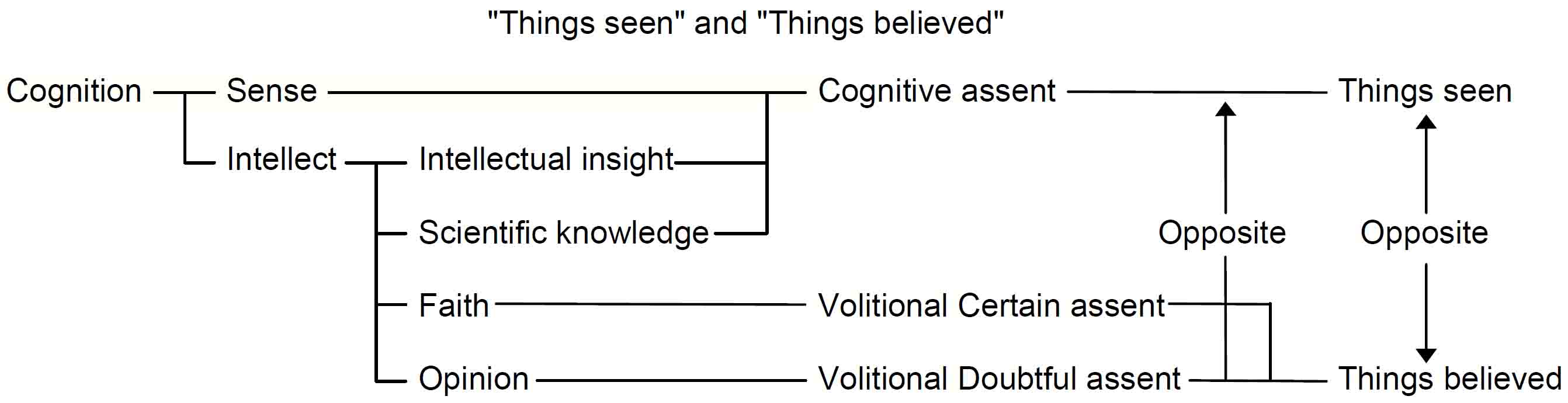
It so, "things believed" can be understood to mean things that are not grasped through sensory or intellectual perception, but are simply believed.
What, specifically, is it? Thomas's Commentary on Romans is cited in the explanatory notes to Ⅱ-Ⅱ, q. 1, a. 4 of the work in question. According to this, "two things are necessary for the formation of faith: one is the inclining of the heart toward faith, which comes from the gift of grace; the other is the determination of the matters to be believed, which comes from hearing."
If we align this with the earlier statement that "faith implies assent of the intellect to things believed", then "the inclining of the heart toward faith" corresponds to "assent of the intellect (volitional and certain)", and "the determination of the matters to be believed" corresponds to "things believed".
In other words, "things believed" can be understood to refer to "articles of faith" or "doctrines" that have been established as things to be believed. Regarding the determination of these "articles of faith", Ⅱ-Ⅱ, q. 2, a. 6 states: "The explicit statement and elucidation of matters to be believed are accomplished through divine revelation; for matters to be believed transcend natural reason."
Regarding how the articles of faith are to be believed, the matter stands exactly as stated in the quotation from the previous translator's note: it is "the inclining of the heart toward faith, which comes from the gift of grace." Furthermore, in Ⅱ-Ⅱ, q. 2, a. 4 responsiones (replies to objections) (3), it states, "Through the light of faith divinely instilled in human beings, they give their assent to matters pertaining to faith", thereby describing the supernatural nature of belief.
Based on the foregoing, the concept of faith in the Summa Theologiae can be formulated as follows.
――Faith is the act of giving firm, volitional assent — prompted by the special working of God — to articles of faith that might otherwise be viewed as lacking a rational basis and merely capable of being believed. Things perceived through the senses, things capable of demonstration, and things known through special intuition are not objects of faith. Moreover, the methods of cognition appropriate to those objects — namely sensing, demonstrating, and intuiting — are not methods of faith. The articles of faith—the objects of faith—are given through revelation, and faith is established when they are accepted through grace. ――
The concept of faith derived here can be confirmed by the following definition of faith given by Thomas himself.
――Faith is a habit of the mind that causes the intellect to give its assent to things unseen, and through which eternal life begins within us. (Ⅱ-Ⅱ, q. 4, a. 1)――
It is noteworthy here that Thomas aligns his discussion with the account of faith found in Hebrews chapter 11 and states that faith is an assent of the intellect. Since "intellect" is a broad concept encompassing scientific knowledge, intellectual insight, faith, and opinion, it is not suitable for use in a definition; however, Thomas's use of the term can be seen as an emphasis on the intellectual aspect of faith.
The above is an excerpt from my essay Christianity Propositional Studies, specifically the section titled "Preliminary Discussion (2): Methodology of Christianity Propositional Studies — 4. On the Overlap Between the Realms of 'Faith and Reason' in Thomas Aquinas's Summa Theologica" (2008; prop.133L1302-1388).
■Consideration 1
[1] Chisholm, Roderick M. "Chishiki no riron [THEORY OF KNOWLEDGE]." Tetsugaku no sekai 4 [Foundations of Philosophy Series]. Trans. Natsuhiko yoshida. Tokyo: Baifūkan, 1980. Print.――In Chisholm's theory, knowledge consists first of self-awareness, then of perception, and next of memory. These are classified as forms of "direct knowledge"; they are acknowledged to possess Cartesian self-evidence and are considered either to require no verification or to contain their own verification within themselves. The next stage of knowledge is "testimony"; while the testifier relies on "direct knowledge" in the form of memory, for the listener, it becomes "indirect knowledge".
■Consideration 2
[1] H.ツァールント『史的イエスの探求』新教出版社 1971年 pp.116-117。Chapter 2 - Easy Study 3 注[2] 参照。
[2]「信仰論」Chapter 2 - Easy Study 3 注[12] 参照
[3] 直観主義論理では、古典論理の「真または偽」に変えて、「真または真の可能性のある不明」を肯定/否定のあり方としている。(「信仰と理性論」Chapter 2 - Easy Study 5-1)「イエスを学問的な意味での証拠なしで獲得し、それでもそのイエスの真であることを主張できるようなイエス」とは、直観主義論理の「真の可能性のある不明」としてのイエスに相当する概念ということもできる。ここには、このようなイエス概念によっても成立可能であるのが信仰というものである、という信仰についての含意がある。
■Consideration 3
[1] 森田雄三郎『現代キリスト教思想叢書2』「解説」白水社 1974年
[2] 小林和夫「聖書の歴史的批評的研究について」『論集 聖書』東京聖書学院 1983年 p.302
[3] J.K.Beilby, P.R.Eddy, The Historical Jesus FIVE VIEWS., Society for Promorting Christian Knowledge, 2010 p.11
[4] R.ブルトマン『原始キリスト教のキリスト使信と史的イエスとの関係』『ブルトマン著作集9』新教出版社 1994年 p.128
[5] E.ケーゼマン『新約神学の起源』日本基督教団出版局 1973年 p.121
[6] J.H.チャールズワース『これだけは知っておきたい史的イエス』教文館 2012年 p.29
[7] M.J.ボーグ『イエス・ルネサンス』教文館 1997年 p.374
[8] N.Perrin, Rediscovering the Teaching of Jesus, Harper & Row, 1967, pp.243-244
[9] I.カント『純粋理性批判 上』岩波文庫版 1978年 p.41
[10] 聖書信仰による保守神学の「史的イエスT」も、聖書信仰の根拠が失われるとそれにより崩壊する。もし、聖書信仰は信仰なのでその根拠が失われることはないということであれば、そのような信仰によって保たれるイエスは「信仰のキリスト」と似た、「心の中のキリスト」であると理解せざるをえなくなる。保守的な教会では、信仰は聖霊によって与えられると教えるが、聖霊が与えるのは信仰、つまりイエスをキリストと信じることについての信仰であって、聖霊が信仰対象を我々にもたらすというのではない。「史的イエス」は信仰対象であって、それは何らかの知識として獲得されなければならないのである。
■Consideration 4
[1] E.シュヴァイツァー『イエス・神の譬え』教文館 1997年 p.179
[2]「信仰論」Chapter 2 - Easy Study 3 参照
[3] R.ブルトマン『イエス』未来社 1989年 p.12
[4] R.ブルトマン「原始キリスト教のキリスト使信と史的イエスとの関係」『ブルトマン著作集9』新教出版社 1994年 p.127(引用内カッコは星加による)
[5] 戸田山和久『知識の哲学』産業図書株式会社 2007年 p.24
[6] N.R.ハンソン『知覚と発見(下)』紀伊國屋書店 2000年 pp.56-60
■Review
[1] このことはカトリック教会に対する新たな批判となりうる。カトリック教会の諸教皇は使徒ペテロの後継とされるが、「キリストの代理」とも呼ばれている。実際、カトリック信者達は、使徒がイエスを眼前にしていた福音書時代の状況を擬似的に現在に保ち続けているのである。しかしこれにより、イエスを失った使徒とイエスを持たない現代人が、そのことのゆえに共有することとなった二段階信仰は、彼らには生じえないものになっている。
[2] K.バルト『教会教義学』第4巻和解論の一(第2分冊)新教出版社 1972年 p.243
[3] 前掲書 p.245
[4] 「信仰と理性論」Chapter 2 - Easy study 1 参照
■補論4
[1] そもそも「聖霊」は信仰による言葉なので、それを用いて信仰を説明することは循環であり、信仰の解明にならない。「信仰と理性論」は信仰を明らかにするのが使命であるので「聖霊」は使えないのである。