| Part 1 The Theory of Faith | Hirohumi Hoshika |
Chapter 4 Acquisition of Jesus as the Faith Object (3)――Overcoming the property of being in the past――
Confirmation 2 The Nature of "Volitional Assent" in Christian Faith
When the truth or falsity of an event is unclear, if a definitive conclusion regarding that event is reached, the cause of that conclusion would likely lie not with the event itself but with the person making the judgment. This is because, as a general rule, judgment is reserved regarding uncertain matters, and one does not draw definitive conclusions from such phenomena.
Similarly, if faith arises when one does not consider the Gospels to be reliable historical records, then the cause of that faith must be sought in the person who holds that faith. ――That said, the doctrinal understanding found in conservative theological texts — that "the Holy Spirit grants us faith" — is not adopted here. For in that case, such an understanding already presupposes faith at the very point of stating that "the Holy Spirit" acts, and thus fails to explain how faith comes into being.
Since dogmatic mystical explanations act as a universal panacea for inquiry, a situation can arise where individuals reach a state of subjective assent while remaining entirely devoid of genuine understanding. Here, we seek to understand how a Christian faith that includes such a "belief in the Holy Spirit" could have come into being, in relation to the acceptance of Jesus as the object of faith. Therefore, let us examine the nature of the Christian faith to identify the factors behind the "emergence of faith amid uncertainty regarding the historical reality of Jesus".
The biblical word for "faith" (πιστιs) encompasses volitional meanings, such as trusting and obeying. Generally, believers are evaluated based on this volitional aspect and are typically viewed as possessing intentions distinct from those of non-believers. However, as seen in John Hick's understanding of Jesus — introduced earlier in Chapter 1 - Essay 3 (and reiterated below) — the faith Jesus preached includes an aspect of perceiving the world.
"Jesus offered a new understanding of the world that allowed us to live rationally in the world as it is, by living the way he portrayed it."
Jesus' teachings — such as "your Father in heaven", "Consider the lilies of the field", "God sends rain on the just and on the unjust" — can be said to primarily call upon people to alter their perception of the world (including God).
Paul, the New Testament author, also states, “ if Christ is not risen, then our preaching is empty and your faith is also empty” (1Cor. 15:14), thereby indicating that the Christian faith is based on a specific understanding of the facts of the world.
Therefore, Christian faith can be said to signify the acknowledgment of certain divine facts. It is said that "faith comes by hearing" (Rom. 10:17), and the "Gospel" heard therein is the "good news" that God has forgiven our sins; thus, Christian faith is deeply bound up with the recognition of such a reality.
Taking this into considerration, if the Christian faith can transform people by influencing the volitional aspect of believers, it is not our noble resolve to follow the teachings of the Bible that brings this about; rather, it is appropriate to understand that a certain awakening within the believer — brought about by a change in their prior perception of the world — is what gives rise to such resolve and actions.
It is this primacy of the cognitive aspect over the volitional aspect that spares believers from the obligation and legalism inherent in acts of faith, thereby establishing an ethics of grace rather than the strict moralism espoused by Kant.
What, then, is the cognitive aspect of Christian faith? In the New Testament, the Epistle to the Hebrews contains the following words, which are interpreted as a definition of faith.
"Now faith is the assurance of what we hope for and the certainty of what we do not see." (11:1 BSB).
The explanation in the Seisho Jiten [Biblical Encyclopedia] is as follows.
"Faith is the acknowledgment of an object that cannot be grasped."
This view of faith as “recognition of uncertain knowledge” has existed since ancient times, and the following passage can be found in the Summa Theologica by Thomas Aquinas, the greatest theologian of the Middle Ages.
"Faith lies midway between certain knowledge and opinion."
This definition of faith originates with Hugh of Saint Victor in the 12th century; Kant, in the 18th century, adopted this view as well, stating the following in Critique of Pure Reason:
――Opinions in general are classified into three stages — opining, believing, and knowing — whereby opining is a judgment lacking sufficient grounds both subjectively and objectively; believing is a judgment for which the grounds are sufficient only subjectively; and knowing is a judgment for which the grounds are recognized as sufficient both subjectively and objectively.
Bertrand Russell, in the 20th century, also stated much the same thing in one of his books.
"It seems reasonable to define faith as a firm belief in something for which there is no evidence."
Thus, since the view of “recognition as uncertain knowledge” is a traditional way of understanding faith and is widely accepted regardless of one’s position, I would like to adopt it as the basic definition of the cognitive aspect of faith.
Since Thomas sets forth this definition of faith in some detail, let us examine it.
"... faith implies assent of the intellect to that which is believed."
According to Thomas, there are two ways in which the intellect acknowledges a matter as true. One case is that of "intellectually insight" a matter or recognizing it as "scientific knowledge", while the other is that of "volitionally consenting" to the truth of that matter.
Although these terms differ from the modern meanings one might expect based on their literal meanings, here, "intellectual insight" refers to axiomatic knowledge that was considered truth at the time precisely because it was self-evident, while "scientific knowledge" refers to knowledge that becomes evident through reasoning.
"Volitional consenting" is further divided into two types: the first occurs accompanied by doubt and fear — termed "opinion" — while the second takes place with conviction and without fear — referred to as "faith".
Thomas' view of cognition
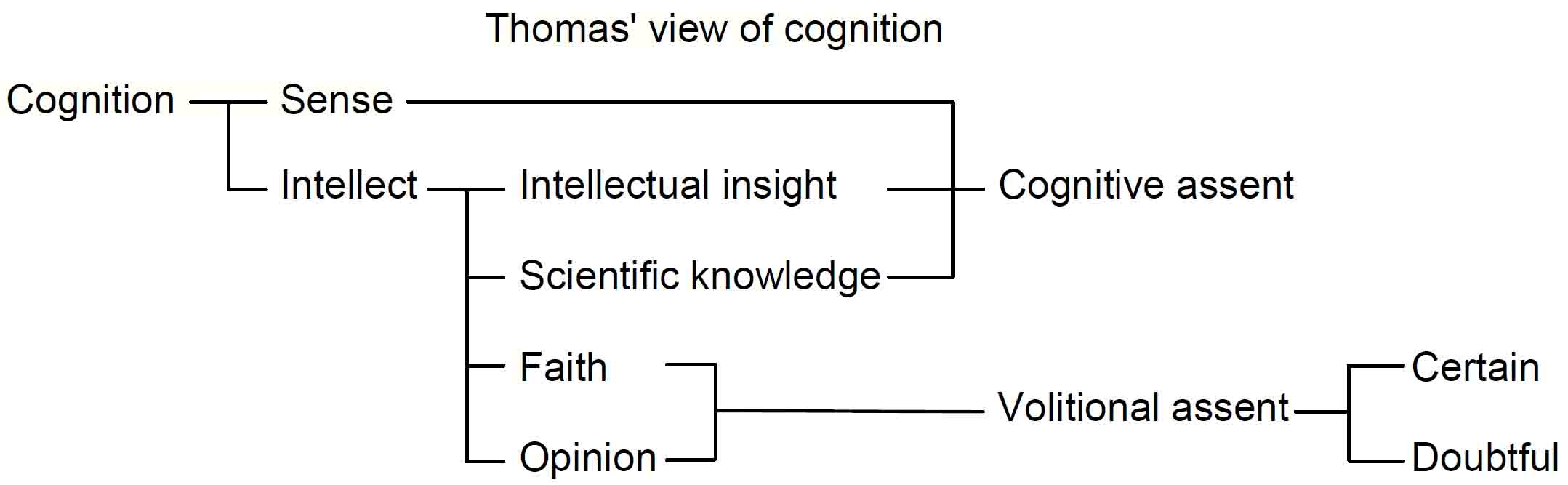
A significant aspect of Thomas' view of cognition — specifically regarding faith — is that cognition through faith is characterized not as "Cognitive assent" but as "volitional assent". ――Here, one must not confuse "cognitive assent" with the "assent of the intellect" mentioned in the earlier quotation. As shown in the diagram, "intellect" is a superordinate concept encompassing a portion of "cognitive assent" and the entirety of "volitional assent", whereas "cognitive assent" stands in opposition to "volitional assent".
Our belief that "God exists" is not a belief derived from "sense" — that is, a belief gained by clearly perceiving God as if He were right before our eyes — nor is it based on "scientific knowledge" derived from arguments such as Anselm's "ontological argument", nor, of course, is it obtained through self-evident "intellectual insight". It is not a matter of such "cognitive assent", but rather a belief that arises when, for whatever reason, our "volition" accepts it as true.
This view of faith held by Thomas — along with Kant's view of faith as "an judgment where the grounds are sufficient only subjectively" and Russell's view of it as "a firm belief in something lacking evidence" — perfectly mirrors the circumstances surrounding the formation of faith among the Apostles, as examined in Chapter 3, "The principle of the establishment of the Apostles' faith". Although they had gained the conviction that Jesus was the Christ through his resurrection, this conviction was a subjective one based on their own interpretation of the resurrection.
Returning here to the methodological concern raised at the beginning of this section, since faith is, as described above, the resolute affirmation in one's volition that a certain matter is true, it can be said that seeking the basis for asserting uncertain facts on the side of faith was, in light of these classical definitions of faith, a reasonable line of inquiry for the time being.
However, the real issue begins here.